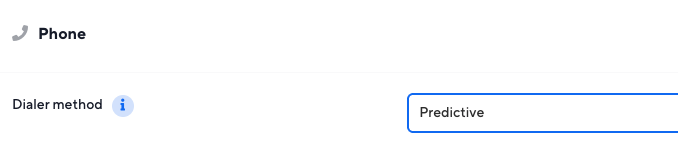

Predictive dialing is particularly useful for high-volume outbound campaigns and is most commonly used in contact centers, fundraising, and sales departments with a streamlined outbound outreach setup.
Because the dialing is based on real-time data, it works better the more agents are on the line. We recommend at least 5 agents online simultaneously to avoid errors and achieve the most effective results.
Even though the system uses real-time statistics to predict how many calls are likely to be answered, errors can occur if it is not properly tuned or there are too few agents online.
This may occasionally cause a short delay before an agent begins speaking, or, worse, a call is answered but no agent is available to take it, resulting in so-called dropped calls.
For this reason, its use is regulated in many countries, often with limits on acceptable abandoned call rates, e.g., in Great Britain.
To prevent this, it is ultimately about finding the right balance between streamlining and minimizing dropped calls, even though our predictive dialer constantly adjusts the dial rate based on settings and behavior.
It is a good idea to check local regulations regarding the number of dropped calls tolerated before activating predictive dialing to ensure compliance.
Anyhow, it is always good practice not to be too aggressive when using predictive dialing and to continuously keep monitoring the outcome of the calls in order to adjust the settings to avoid errors or high drop call rates.
The dial rate specifies the number of active calls requested per active agent. A dial rate of 1.0 indicates that the system must have the same number of active calls as agents.
The higher the dial rate, the lower the wait time for agents between calls, but at the same time, the number of calls that can't be answered will, inevitably, be higher.
If you experience too many dropped or abandoned calls, you may need to lower the dial rate, especially when making or selling fundraising calls. It may be intimidating for the lead to receive a ghost call. Worst case, you’ll miss an opportunity.
In Adversus, you can track all data parameters that affect the predictive dialer.
By digging into these data, it’s possible to adjust the dialer accordingly, e.g., based on the number of agents currently in an active call, the number of leads being called, the average waiting time, the contact rate, the drop rate, and the number of failed calls. Adversus measures activity within the last 5 minutes.
Current contact rate
Out of all calls placed, what percentage pick up the phone?
Current AMD rate
Out of all calls placed, what percentage has the Answering Machine Detection discarded?
Current drop rate
Specifies how many calls are dropped, e.g., a lead picks up, but there is no available agent to take the call.
Recently failed calls
Tells you how many calls failed when dialing, e.g., due to an invalid number or incorrect formatting.

Auto dial threshold
The auto dial threshold specifies the maximum dial rate per available agent. This is to ensure that the predictive algorithm does not initiate an unrealistically high number of calls. Normally, we recommend using the decimal range 2, but where to put it also depends on how many agents are online and the outcome.
Instead of adjusting the dial rate threshold, it can sometimes be more useful to adjust the Intensity dial level: how quickly you want the dialer to react. You can either make it faster or slower, e.g., so the dial rate adjusts upwards faster when there are available agents, but adjusts downwards more slowly when the number of agents decreases, or vice versa.
Are you struggling with having too many dropped calls? You need to adjust the adaptive drop rate limit that specifies the percentage of dropped calls allowed. You can also adjust the Maximum dial time, which is the maximum number of seconds allowed to pass before a call is dropped if an agent does not answer, typically in situations where there are too few agents online.
Finally, adjusting the Maximum ring time for how long the predictive dialer tries to call a lead before saving it as ‘Not answered’ can help prevent dropped calls, but is more likely to be used if you want to optimize the number of calls pr.
At Adversus, we’ve made it mandatory to use inbound for all outbound campaigns, not only for compliance reasons, but also because we believe it is best practice to be transparent when calling. It allows the lead to identify the callee because it’s possible to call back any given phone number.

Go nuts in data. Warehouse lets you explore all your data on everything from leads to calls. Control and find whatever you want to with just a few clicks.

Let agents register sales while speaking to the lead. Easy management of your products and a swift overview of all sales in currency and quantity.

Direct two-way integration with your favorite calendar app. Make sure all meetings are always up-to-date and bookings are easy to manage.


.svg)